
What makes for a good leader? Michael Jordan, Julius Caesar, Cleopatra VII, Harry Potter, Miranda Priestly, Harriet Tubman, Neil Armstrong, Winston Churchill, Steve Jobs, military officers, small group leaders, Mom, Dad, and Jesus Christ are names in varied domains of society that have represented leadership to us throughout history. There is something within us that registers when we hear those names – probably something relating to a mixture of their ethics, ambition, humility, charisma, teamwork, resilience during chaos, sacrifice, foresight, and courage. With many ills in our time today, one of which we see is both a decline in the quality of leadership and a decline in the quantity of leaders among us, both in comparison to previous generations.
For some odd reason, whenever a true leader (or hero) does emerge in the public space many people respond with envy and we fixate on the flaws of that person. Not only do we collectively, consciously or unconsciously, hinder the rise of potential leaders, but we also hinder our own urge to lead. We need a revival of leaders in our world. From every sector of our institutions. With effects ranging from empowering our youth to strengthening the core of our societal values and breaking the chains of conformity. If not, our civilization will continue to slip into an unconscious chaos.
Anthropologist Ernest Becker says,
“In our culture anyway, especially in modern times, the heroic seems too big for us, or we too small for it. Tell a young man that he is entitled to be a hero and he will blush…if everyone honestly admitted his urge to be a hero it would be a devastating release of truth. But the truth about the need for heroism is not easy for anyone to admit…”
We can see this decline in various places: In the lack of trust in our government leaders, disrespect for authority figures like police officers, decrease in church discipleship, the decline of marriage rates, increase in divorce rates, the rebuke of dissenting opinions online, increased depression, the aging workforce, the decay of the honor of family and religion, the watered-down depiction of leaders in Hollywood, etc.
Why did this happen? How did we get to this place of lesser leadership in the public space?
For a caveat – someone may rightly say that they DO know many healthy leaders around them. To that, I say that is anecdotal. It is wise for us to be mindful that things are rarely as simple. When we seek to find the cause of anything socio-relational it is important to first acknowledge that there are likely several variables at play over a lengthy period of time. In this case I believe that we will see a perfect storm of intersecting factors.
Another caveat is that we need to not compare our anecdotal personal lives to that of all of society. We need to understand there is a distinction between what it means to be an individual and what it means to be a population. And that analyses of the state of a civilization, for example, deal with populations. They don’t have much to say of what individuals are nor are capable of. Populations and individuals are different. We are looking as mass populations, trends, and data.
So again, how did we get here?
Reason #1: CODDLING TOWARD EXTINCTION
Our generation has grown to have weaker relational and mental capacities compared to past generations. There have been countless studies and articles this past decade alone addressing how mental health is a growing problem and technology’s negative effect on our ability to do life with one another. What we are not acknowledging is how this also limits our capability to create new leaders.
Leaders are required to be able to communicate effectively in order to reach certain goals. One way we can measure this drop is by looking at authors of old, say Leo Tolstoy or the founding fathers, versus authors today. Linguists have broken down the analysis of vocabulary to find that the authors of old had greater range and complexity than authors today. By deduction their audience was able to receive such range and complexity leading to a more advanced harmony of communication. This isn’t the case today. Effective communication aides leaders in building relationships and networks. The stronger the network the stronger the effectiveness. Mass media, among other things, has watered down our relationships which also inhibits this harmony piece between leader to population or even person to person.
Over time there has been progressive coddling placed on children that affect them well into adulthood. The freedoms our grandparents had as kids to roam the streets, play outside, accidentally hurt themselves, get lost, and gain life experience was more than our parent’s generation when they were kids. This occurrence was no accident. Outside of generationally cultural differences due to our grandparents growing up in the post-World War II era vs our parents growing up in Countercultural Revolution of the 60s/70s there is also the fact that crime increased and the fabric of trust decreased.

As crime increases parents naturally increase the protection of their children which decreases the freedoms of that child. This is wise for parents to do but there are consequences – especially when this “protection” evolves into helicopter parenting. In addition to literal, increased crime, the general awareness of the existence of crime has the same effect. An example would be the advent of 24/7 news networks filling us in on the daily evils around us – one of them being kidnappings.
The fabric of trust in our society decreased partly due to the rise in secularism, a term that will be investigated more later. With this secularism came a more non-judgmental approach to behavior, a de-emphasis on punishments and an emphasis on “fair shares for all”. Economist Thomas Sowell gives an illustration by speaking on A Tale of Two Blackouts which happened in New York. In November 1965 and July 1977 NYC experienced similar electricity blackouts that left the city dark overnight. In 1965, the crime rate that night remained the same. Conversely, in the 1977 blackout crime skyrocketed with mass arson and looting. What happened that the same city with identical blackouts yielded different behavioral patterns? In America as a whole, murder rates, rates of infection with venereal diseases, teenage pregnancies, and drug use were among things that were on a steep decline but then suddenly reversed in the 1960s. In 1954 London there were a total of 12 armed robberies. Two decades later they were at 1,400 armed robberies in a single year in London.
Other examples can be the fading away of Pay-After Gas Stations and Exchange Buffet restaurants. There was a time when after you finished eating at a buffet restaurant you’d go to the cashier and tell them how much you owe. Same with gas stations. This model lasted for almost 100 years but collapsed in the 1960s because people stopped being honest. Seeing these moral shifts, parents restructured their parenting techniques accordingly in order to keep their children safe.
Comparing our parent’s childhood to our childhood, we see again that the older generation had more freedom than our generation. Same with the millennial generation compared to Gen Z. I use these comparisons not to point blame nor to even say that one generation is better than the other. The purpose is to show that there are causes and effects to our decisions and the ideas that we subscribe to. In the end this coddling of our youth reduces their development into freedom.
With a lack of freedom comes a lack of ability for us to step beyond the box, a key component to leadership. A coddled generation has a hard time growing leaders because the mental state of a coddled person is a weak state. There are important features of childhood that need to be experienced in order for a person to grow into a mature mental and emotional state. The ability to explore as a child, go through failures, fear that things will not work out, and then finding your way back home is irreplaceably formative. Today, the child is more sheltered and no longer allowed to explore. A coddled generation is more likely to not want to offend anyone. A coddled generation has mass indifference largely due to their lack of life experiences. It is no longer a goal to “Let your yes be yes and your no be no”. Now it is acceptable to answer “maybe” or “I am interested”. To coddle someone is to birth their mediocrity. And there was never a hero praised for their mediocrity.
The more coddling that people buy in to, which affects our mental and emotional state, the more fractured our cognition gets, the less capable we are of having a coherent worldview and building it from first principles.
Reason 2: WEAKENED INSTITUTIONS AND PLATFORMS
A separate hindrance on leadership has been the elevation of personal platform in our institutions. This places more value in being seen than on actual results. Our institutions are the durable building blocks of our common life that work to educate the young, make laws, defend the country, strengthen our marriages, serve God, help the poor, or produce some service or product. Political theorist, Yuval Levin, describes the purpose of institutions as:
“Institutions form people so they can carry out tasks successfully, responsibly, and reliably. It fosters an ethic that defines how they go about their common work, which in turn, shapes their behavior and character.”
Institutions are the workplace, family, church, local community, university, media, legislature, military, healthcare, and other structures in society. Sadly, our institutions are failing.
Our institutions have weakened due to a variety of issues. For one, scandals and ideologies took their toll. The publicly known sex scandals of the Catholic Church and some evangelical churches affected the trust of The Church. The sex revolution and gender role confusion affected the family. The reliance of globalism and the connectedness of social media affected the local community. Politicization and commercialization belittled the university. Political theater, cover-ups, polarization, propaganda, identity politics and anti-western populist sentiments diminished the view of both our government and media. On and on and on it goes.
Why should we respect the church if it would allow such a thing? Why have faith in our government if we have witnessed the hypocrisy? Why have confidence in marriage when we have seen divorce and infidelity all around us? We feel betrayed by institutions that were supposed to protect us with integrity instead of the corruption of serving those within it.
With our institutions weakened we individually struggle to understand what has gone wrong and what to do about it. We have little reason to believe they will have our best interest in mind. Without these institutions forming and molding us we end up with a population that doesn’t have a strong foundation to stand on. This includes people lacking traits to be effective leaders since that foundation has been weakened. Without a strong foundation of trust and responsibility leadership becomes a moot point. Without institutions, there is no organized to lead under or be led toward.
As always, words matter. The definition of “leadership” is now converged into “influencer”. That is, people like Donald Trump, Barack Obama, Alexandria Ocasio Cortez, popular journalists, and others are sometimes more concerned about their social media following that anything else. The journalist at New York Times does not need to worry about working within the bounds of the platform of the company. That journalist has tens of thousands of social media followers allowing themself to be ruler of their own platform. The journalist’s goal is not to be molded by the institution of NYT but rather to gain celebrity and status via social media. This doesn’t make the person subscribing to this bad. This is simply the air we breathe now. It used to be that people get a mic to get power and then change things. Today people seek power to get a mic and then talk about things.
This concept parallels something that German Historian, Oswald Spengler, wrote in his 1918 book titled “The Decline of the West”. He coined the term Caesarism to describe the cyclical final stage of a civilization on the decline. Spengler didn’t see history on a linear timeline nor as epochs pointing to notable points in history. He instead rightly saw civilizations as mimicking cyclical lifeforms that begins with growth and momentum and eventually ending with decline and extinction. This view is backed by Christian apologetic’s teleological argument on nature which basically says “what is true of the part is true of the whole.” Meaning if the lives of tiny organisms are cyclical, then the human experience is also cyclical, which makes civilizations cyclical. This is because God’s story is cyclical. This is why we say that history repeats itself. For this reason it is important for us to consider Spengler’s point.
Caesarism is where new leaders rise during internal/external struggles, polarized tribalism, social turmoil, and a decline in creativity. In this phase political leaders are seen more as saviors rather than as politicians. Spengler gives the examples of the fall of Rome, Greece, the Babylonians, Arabians, and several others. Moderate forms of Caesarism can be Abraham Lincoln. Current examples can be Putin’s Russia, Narendra Modi’s India, and Erdogan’s Turkey, to name a few. This is not to say that these leaders are inherently bad. But rather to show that the climate that brings about such a leader is a potential indication of decline.
This makes it important to consider how we mold and pick our leaders. Because the way the general public views leadership has also shifted. Studies show that young people want more authoritarian/strong-man rule. Younger generations are more open to an authoritarian leadership style than previous generations. We’ve become inclined to view a good leader as someone with a sizable social media presence. Someone who is entertaining. Someone who can save us. Or as someone who agrees with our current narrative – otherwise we will unfollow them and find someone else more suitable. The few true leaders we have on social media are not effective leaders (compared historically) because the functional role of the people receiving the leadership is functioning as consumer rather than citizen. With this decline of what a leader is today, similarly to the decline in religion, we will merely look for this gap in a political party, the state, or technology. All inadequate.
Reason #3: SECULAR INDIVIDUALISM
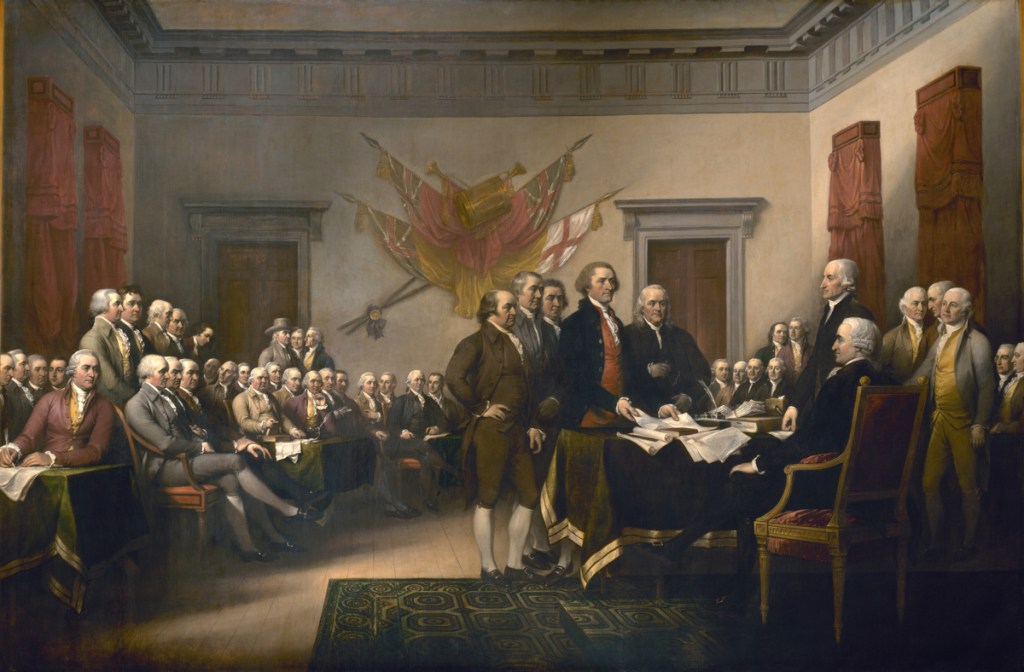
As spoken on in my previous posts, since The Age of Enlightenment period of the 18th and 19th centuries we have seen increased secularism in the western world. First we saw a shift away from religion toward modernism (rational secularism). Then in the early 20th century this morphed into postmodernism (irrational secularism).Secularism is still fool’s gold, regardless of modernity or postmodernity. But I distinguish with the terms rational and irrational to show there is a hierarchal value of reason when moving from modernity to postmodernity. Modernism values reason. Postmodernism does not. This rate of secularism was sped during the countercultural revolutions of the 1960s and accelerated again by mass media today.
To see how this affects leadership, it begins with secularism bringing about individualism. Secularism takes the focus from God to humanity. To focus on our individual self is to ignore what is good for society. Religion allows for construction and guidance of leadership because the prerequisite of a leader is to have objective values of the highest of morals. One man values drugs while another values to be a good father. The former is a moral wrong while the latter is a moral good. Secularism brought about from modernity, which does value reason and objective truth, still allowed for the principle of leadership to flourish in the late 19th and 20th centuries – even though the foundation slowly began to weaken during this time due to this secularism.
Postmodern secularism dismantles leadership. It brings about moral relativism which states that there is no objective truth. Moral relativism removes the construction and guidance that we need in order to achieve anything of meaning. Moral relativism claims there is no such thing as an objective good. It creates a sense of anti-authority because authority is equated to oppression. It creates cycles of contradictions. The professor teaches that ideas created by the western world are corrupt, and then he offers the western-created idea of Marxism to fix it. In a book on history we attack different people for their behavior, and then in a book on social equity we attack the idea that people’s differing behaviors matter. We praise the person with more social media followers then wonder why depression among teenagers has risen. The good feminist of old fought for women to be equal, but the good feminist of today fights for men to be women. Before The Enlightenment people were skeptic of themselves. The Enlightenment people were skeptic of God. Today’s people are skeptic of everything. In being skeptic of everything we can no longer change anything.
Why is it important for our value system to be objective? Without objective truth the “leader” has no strong value system. Nothing the guide him or her towards. Nothing to measure with. We need objective approval and disapproval; we need reverence and contempt from ourselves and others for the ability to measure our current state with a desirable future state in order to make value judgements. But with a subjective worldview that measuring will not be an effective tool for leadership because it is based on a weak, self-created foundation – the individual. For example, today we have a tendency of measuring our progress by technology and social media approval. The Christian once used the marker of Christ. The Enlightenment person changed the marker to other humans. The people today use the marker of shares and likes. We identify ourselves with the technology and the technology changes us.
If this is the air breathed by the western world then it is hard to have people come forth from that population who have the ability or desire to lead. Furthermore, any outsider looking in who disagrees would be likely discredited by us for not understanding how things are ran here. But to deny the realm of objectivity is to deny what makes us human. This leads people either to fundamentalism or meaninglessness depending on their proclivities.
Men and women need to make good, prudent decisions that aren’t short term thinking. We need to set up our respective family, workplace, community, church, government, military, and even our sports team well. In the historical novel, A Place For Greater Safety, author Hilary Mantel describes events of the French Revolution directly following the killing the king. During the early meetings of Parlement when they were writing the new constitution she writes,
“Some were heard to mutter that the Assembly should write the constitution first, since rights exist in virtue of laws, but jurisprudence is such a dull subject, and liberty so exciting.”
She explains that instead of beginning with forming laws they instead focused on the rights of people as their foundation. This type of flawed thinking is what we see today. That individual rights are most important for true freedom. This cannot be further from the truth. Laws bring about the structure that shows us what we are supposed to do. In knowing what we are supposed to do it gives us the freedom to be able to do what we want to do. Individualism is the antithesis of leadership.
Reason #4: MASS CONFORMITY
“For nonconformity the world whips you with its displeasure”
-Ralph Waldo Emerson
People have become cowards. We live in a society of hyper conformists that is a multi-decade process in the making. This topic of conformity is where behavioral contagion is at its peak more than the other reasons for the lack of leaders – since conformity is easy to imitate like a spreading pandemic. The attraction of conformity is that it provides people with security and comfort making them feel as if they’re participating in something significant. Granted, some conformity is a natural good. To function within the institution of the military there needs to be some conformity. The football team needs to conform to the guiding philosophy of their coach. However, like everything else, there are degrees when it goes too far. One sign of things going too far is vilification of anyone who goes outside the conformist’s vision. Or when social validation is the most important thing in the minds of the masses.

As conformity becomes the norm and the social policy followed by the general public, it does something to the psyche of that population. It hinders leadership because it creates a positive feedback loop of more conformists. This happens because to see other people exercise independent judgement, self-responsibility, and self-reliance, disturbs the conformist belief thus threatening their sense of identity. It leaves the conformist feeling powerless and anxious so all they can do is follow.
Therefore, people who value social conformity (the growing majority of us) enforce conformity onto others. People will be targeted and suppressed to the extent that they challenge social conformity. Mass media empowers this ability. Fifty years ago any conformity was primarily enforced by members of one’s direct community, whereas now we have the added weight of online social networks, opinion news outlets, and the connected institutions surrounding us. Social success is gained by virtue signaling. This type of environment breeds cowardice tendencies and suppresses leadership tendencies.
We’ve lost our culture of self-reliance. We’ve grown more dependent over decades due to morally neutral concepts. Today, 15 year olds spend almost all their time with other 15 years olds. This is weird compared to human history and has been happening more since the Industrial Revolution introduced public education. This is not to romanticize the past nor to say that public schooling is wrong. This is to say that like everything else there are causes and effects. Before the Industrial Revolution for most of history children spent most of their time with their families. By doing so they matured quicker and learned a more consistent value system. Nowadays kids spend most of their life with other kids. This life together has exponentially increased over the past 30 years with the internet and social media. Now 15 year olds are primarily influenced by other teens around the entire world. Doing life less with adults makes it easier for the youth to remain adolescent in thought even into adulthood. Reducing our sense of self-reliance. Reducing trust in ourselves to make our own choices. Thus losing our ability to lead.
WHAT NOW:
These four intersecting storms are culminating into societal chaos. GK Chesterton would call this The Suicide of Thought. CS Lewis would call this Men Without Chests. Kobe Bryant would call it a Lack Mamba Mentality. I call this The Collapse of the Modern Leader. Because better leadership can reverse this tide. These leaders are parents, institutions, coaches, small group leaders, firefighters, politicians, and friends.
Our big, collective brain of society has stagnated itself and it is true heroism in all sectors of society – the family, community, education, church, government, law enforcement and others – that can rise above it. Otherwise, by basking in our mediocrity we have lost our ability to yearn for anything. By crippling the ability to create leaders we’ve created a vacuum of our decline. By removing ultimate objectivity we have removed our guiding light. And by creating conformists we have surrendered our personhood. But there is hope. As my dad has always liked to tell me, “It ain’t over til it’s over.”




 A Fun & Outgoing Introvert
Leave a comment