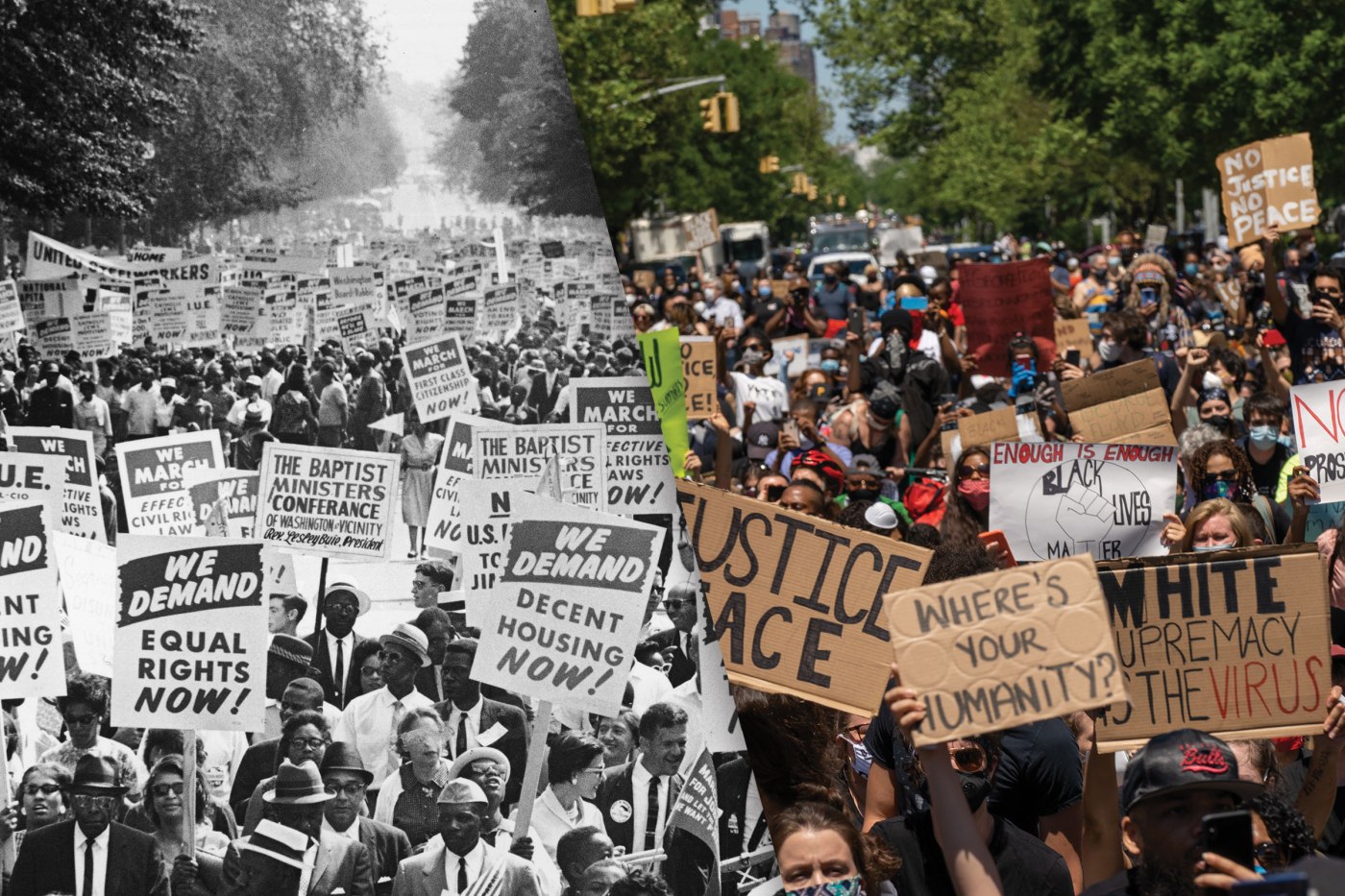
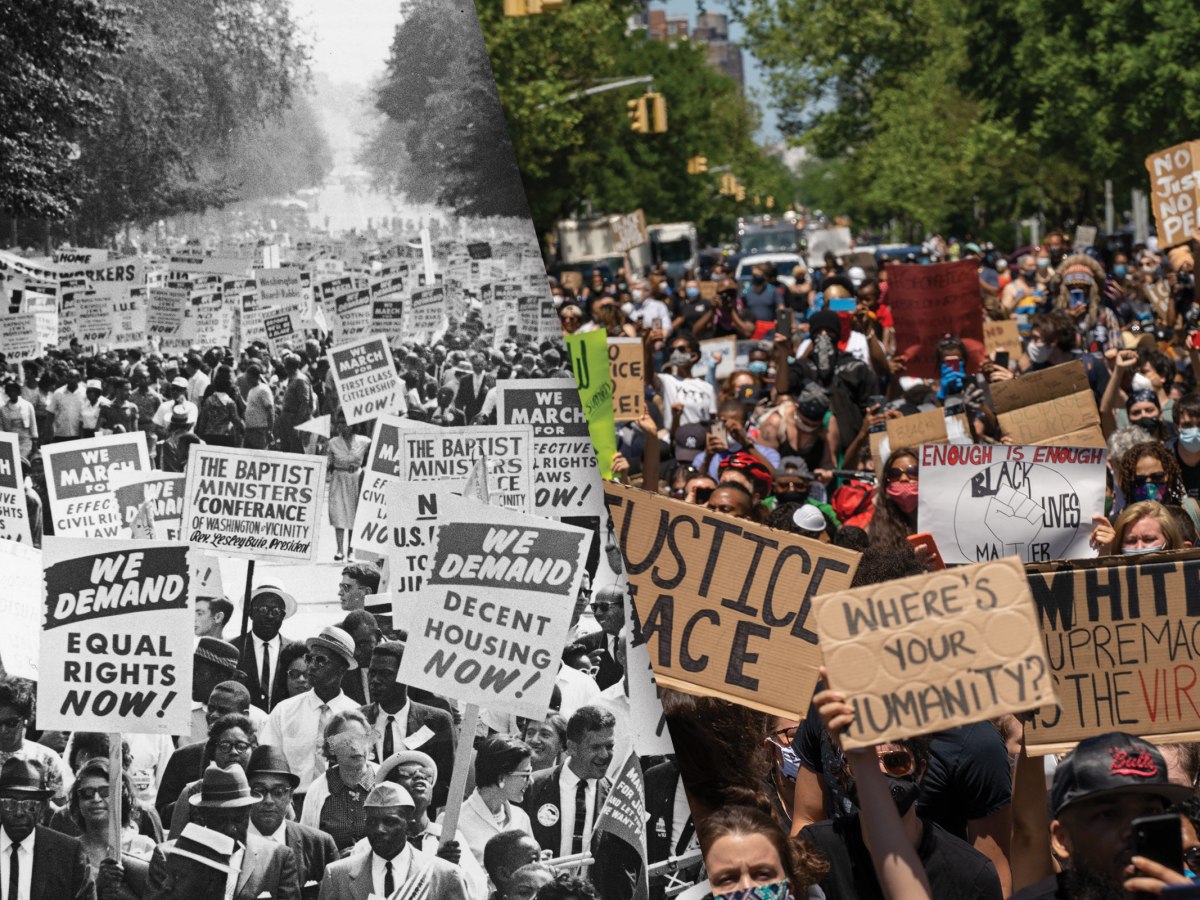
Something we consistently see throughout history is the power of language. Language gives civilizations tools for flourishing. Language builds friendships, gets politicians elected, and can build unity around similar goals. On the other hand, language can end friendships, start wars, and revise history. In short, for good or for bad, language is a tool to get what you want. The meaning behind a word is where the power of that tool lives and breathes. With that in mind let us always ask who gets to define a particular term, by what standard are they defining it, and what are the possible results of defining it in the manner that they choose.
Today we find ourselves at an impasse on what racism means and therefore how to defeat. There has been a [successful] gradual attempt at shifting the language centered around society and culture. We now see two competing visions of racism in our history: (1) The humanist vision and (2) the anti-racist vision.
- Humanist Vision (The Traditional concept) – In this view, a person’s skin color is meaningless because to attribute meaning to the amount of melanin someone has or doesn’t have is illogical. To think, act, or operate as if you are superior is irrational. Therefore, it is equally irrational for anyone of any ethnicity to be racist toward another ethnicity – whether they are White, Black, Hispanic, Asian, Indian, etc. Anyone can make the same illogical mistake. This is an objective concept.
- Anti-Racism Vision (The Critical Theory concept) – In this view, skin color is not meaningless. Racism is defined by looking at historical power structures of oppressor vs oppressed. Your skin color matters in that if you are seen as an ethnic minority then you are a victim who is oppressed by the historical/cultural hegemony – which are white, straight, able-bodied men. Therefore, by definition, a black person cannot be racist toward a white person. This is a subjective concept.
In the humanist vision there is ethical symmetry in the meaning. Martin Luther King Jr. famously said, “Black supremacy is just as dangerous as white supremacy. God is interested in the freedom of the whole human race and the creation of a society where all men will live together as brothers.” MLK hoped that we would be judged by the content of our character and not by the color of our skin. There is a sense of colorblindness in this humanist concept of racism. MLK would not deny that the power of white racism was much greater than the power of black racism in 1960s America. However, King’s goal was a universal guiding principle in order to achieve sustaining unity. Popular advocates of this concept are Martin Luther King Jr., Phillip Randolph, Bayard Rustin, John McWhorter, Thomas Sowell, and Shelby Steele.
In the Anti-racism vision there is ethical asymmetry because there was asymmetry in the past with how white people treated black people. As the author and Anti-racist scholar Ibram X. Kendi recently wrote, “The only solution to past discrimination is present discrimination. The only remedy to present discrimination is future discrimination.” For this reason they are against the idea of colorblindness. Popular Anti-racist advocates are Malcom X, The Black Panther Movement, Ibram X. Kendi, Robin Deangelo, Ta-Nehasi Coates, and today’s Black Lives Matter Movement. The Anti-racism view believes that the humanist view is not bold enough for the action that is necessary in order to battle what they see as current systemic racism. The Anti-Racist vision is the newer concept that we see increasingly popularized today in mass media and throughout our institutions.
How did Anti-racism become the more popular taught view?
Two philosophical views have grown in our western world in order to get to where we are today with Anti-racism: Postmodernism and Critical Race Theory.
Postmodernism is a philosophy that first arrived in the late-19th century and really began magnifying with success during the hippie/counterculture movement of the 1960s. Postmodernism is the belief that there is no such thing as objective truth. It states that it is impossible to use reason in order to come to truth because truth is relative. Postmodernism rejects structures of western civilization such as The Age of Enlightenment, Christianity, the scientific method, and authority. We will see why these rejections are important later on.
This idea is far more well developed and attractive in our country than any of us have yet to realize. It dominates the humanities and social sciences in our education system. The idea of relative truth matters because if I, as a black man, claim that something is racist I no longer have to give objective proof or reasoning because, regardless of any fact, it still made me feel like it was racist. My truth is my truth – therefore it is racist. My lived experience as an black man gives me a special insight to reality that white people cannot attain. This is why we may hear people today say things such as “check your privilege”, “the facts of the case don’t matter”, “you are victim blaming”, and “I don’t care what the statistics say”.
Critical Theory is a worldview that tries to understand how power operates and circulates within society to reproduce systems of inequality and oppression. This includes gender studies, race, class, sexuality, and general social justice. As a result, we are taught over time not to see ourselves as part of a whole but as part of subgroups. Critical Race Theory focuses on the white ethnicity as the oppressor and any person of color as oppressed. Any form of “whiteness” is seen as a plant by white dominant culture in order to continue their own privilege and self interest. Ideas such as liberalism, objectivity, being on time, competition, the nuclear family and hard work are seen as oppressive tools of white culture according to Judith Katz (1990), The African American Museum of History and Culture (2020), Robin Deangelo, and Black Lives Matter. Now we have the ability to claim a prevalence of racism without the need for an actual racist person or racist act to point out.
While Critical Theory was birth in 1930s Germany, Critical Race Theory eventually grew in popularity in the 1980s. It was able to easily gain speed because of the educational presence already established by Critical Theorists in journalism, the political system, and universities. The idea of oppressor vs oppressed is necessary in order for people to claim that the entire western civilization is racist. Civilizations are by their nature hierarchical – from the NFL, the workplace, the classroom, tv ratings, the dating scene, and in every other creative entity there is a hierarchy built within. Critical Theory uses this natural human phenomenon for its own semantic purposes.
These two principles, Critical Race Theory and Postmodernism, give birth to the influence of Anti-racism.
Why is the Anti-racism view destructive?
The term Anti-racist sounds simple enough. By the name alone, I would be anti-racist because I am 100% against racism. However, the deeper meaning behind the term changes everything. Anti-racism believes that any ethnic disparity between white people and black people is solely due to racism. Such disparities are typically described in imprisonment rates, college admissions, income, housing, policing bias, and other categories. Thus, in order to account for these ethnic gaps, racism must now also be classified as systemic, in some abstract form, “in all aspects of society”.
So, by definition, the presence of any disparate outcome automatically “proves” the existence of systemic racism (without performing any prior multivariate analysis). The complex factors of differing cultures or circumstances between ethnic groups do not matter. The difference in morals and value systems across cultures do not matter. The negative effects of hip-hop music on black culture do not matter. Objective data disproving the police brutality bias between races does not matter (I highly recommend this article). The effects of the welfare state or fatherless homes do not matter. The fact that from 2001 to 2017, the incarceration rate for black men declined by 34 percent does not matter. The fact that there are also wide crime and income disparities between White Americans of differing descent (Russian, Irish, British, Polish, Northern states vs Southern states) due to their own differing subcultures and histories does not matter. The fact that Asian men and women earn more than white men and women does not matter. The fact that Black African and Black Caribbean immigrants in America make 30% higher income and attain college degrees at higher rates than U.S.-origin Blacks (while being subjected to the same amount of racism today) does not matter. And whatever you do…never…ever…talk about the high occurrence of black people killing other black people or disproportionate black abortion rates. The only possibility that matters is racism.
To strive for some sense of racial equity while simultaneously ignoring a plethora of factors hindering it is to then strive for something that can never be achieved (unless via totalitarian efforts). Therefore, the claims of systemic racism will never be able to end for many years to come. What is very unfortunate is that the bad pathologies within the black community that we do need to address will not get fixed because the real problem is said to be racism.
This concept can also develop a victimhood mentality that hinders one’s desire to aspire for anything. Which, by the way, is understandable because why aspire for anything if the system is already rigged against you? So those pathologies will only get worse causing many of the ethnic disparities to worsen. By fighting past racial discrimination with present/future racial discrimination against white people we are all setting ourselves up for a perpetual grievance machine toward one another.
By the power of the Anti-racism vision any white person who disagrees is labeled “racist”. According to best-selling author Robin DeAngelo, that is their white fragility showing. So you have two options as a white person: Either (1) admit to your racism and its systemic presence throughout society or (2) you are hiding your own racism. Whites are to be silent and listen to black people – unless you already agree and in that case you are allowed to speak. Conform or be shamed.
If you are a black person who disagrees with any aspect of Anti-racism then you have internalized racism. For example, if you are a black police officer who does not believe that law enforcement is systemically racist today then you are perpetrating racist oppression against your own people. Shame. You shall be called a sellout and Uncle Tom. No one can challenge this new racial system of belief. It has a well-rounded way of forcing conformity on all fronts.
What is the possible end result?
The popular Anti-racist vision cannot achieve lasting racial unity nor reconciliation. Critical Theory resulted in destroyed societies during the 20th Century. Intimidation is not a sustaining formula for a long term relationship. Many things that Martin Luther King Jr. said on the topic of race would not be accepted today by Anti-racism scholars. Anti-racism is an abstractly redressed look at history. By design it has no sustainable solutions or specific end goals because it relies on there always being oppressor and oppressed groups. The only solution is to undo the entire Westernized system itself. It looks for a utopian society when true utopia is only found in God’s eternal kingdom.
The humanist vision is actually in the scope of human ability by taking a gradual, reformed approach. The outcomes and consequences of both these visions are very different. One of the problems we are seeing today with all the divisiveness is that some of us are working from one racism vision while others are working from the other vision. The distinctions between the two visions are also on more of a spectrum than a binary.
Of course there are many genuine, well-intended people who are for the Anti-racism vision. They just want change for a better future and are pained by inequalities they see (rightly or wrongly) today. Many of the people who believe it don’t know what Anti-racism actually means. Some were explicitly or implicitly indoctrinated into Critical Theory while in college. Some just like using terminology held within it (e.g. intersectionality, safe space, equity, etc). The tenets of these teachings are plausible to an extent – especially to anyone whose personality is high in empathy. Even so, this is a problem. But their voices should not be silenced either. We need more dialogue and less demonization.
Racism is real. Definitions matter. Ideas matter. Outcomes matter. Martin Luther King Jr. may have been on to something when he spoke on ethnic equality in a symmetrical manner in order to fix it. Maybe MLK understood the Christian tools of universal truth, grace, and forgiveness in a manner that Postmodern scholars, Critical Theorists, and Anti-racism scholars have yet to grasp. Maybe those scholars have purposely chosen not to grasp it in the first place. Let us be very careful but not complacent any longer.




 A Fun & Outgoing Introvert
Bravo, bravo, sir. This thought piece needs to be heard and shared and conversed upon.
My man! Great analysis. It was balanced, honest, and full of grace.
Very well said, Mr. Johnson. As a Kairos Prison minister I’ve been inside Perry Correctional at least a dozen times and I’ve held convicted murderers as they sobbed through confession. Every one I met all wished for a strong father figure, someone to teach them right from wrong. They didn’t blame their crimes/punishment on government, skin color, their attorney, their teachers. All they wanted was something they never had, a strong father figure.
So insightful Earnest, thank you for sharing
That was a long essay and yet there wasn’t much to it. You had a conclusion where you combined anyone you disagreed with into one generic mass of anti-racism and then cherry picked evidence to support it. And as typical of liberals like you, you prop up a caricature of Martin Luther King Jr. where it’s like anything he did after the “I Have a Dream” “speech never existed. What a waste of such e you’ll get your head pats from those who only want to hear from Black people who reinforce their weak worldview.
Thank you for the encouraging reply. Interestingly your reply had no direction in itself and no meatiness of dismantling anything I said. You only seem upset about the way I said it. Maybe it’s because you know I’m right. Maybe you should critique the theologians of Anti-racism for their own lack of clarity of the wholistic definition(s) of Anti-racism. Also, to the contrary on disagreement, actually Kendi says anyone who disagrees with Anti-racism is lumped into one generic mass of the category of racist. Funny how that works. But are you calling him out?